July 2026 Monthly Chemical & Tanker Report
Brent crude jumps 55% as the Strait of Hormuz escalation reshapes freight markets. SPI Marine's July 2026 chemical tanker market report and fleet... Read More.
August’s defining story was a sharp reversal in the Far East CPP market, where the Baltic’s MR Pacific basket nearly doubled and pulled South Korea and West Coast India rates higher, encouraging owners to stay in the Eastern Hemisphere. US Gulf export lanes moved the other way, with Northwest Europe, the Mediterranean, ECSA, and Far East chemical routes all ending the month softer as vessel supply continued to outpace demand. The Strait of Hormuz entered its seventh month of disruption without resolution, low Rhine water levels curbed European chemical production, and Brent crude climbed back above $90 a barrel.
August across the Americas outbound (USG) tradelanes told two stories moving in opposite directions. The bulk of the volume, on the Mediterranean, Transatlantic, ECSA and Far East lanes, spent the month absorbing an oversupplied tonnage picture, with non-regular and outsider vessels accumulating on position lists and keeping prompt freight under steady pressure even where headline rates held flat. West Coast India and West Coast South America moved the other way, opening the month in balance or on a soft-to-stable footing and tightening into September as owners pulled vessels out of rotation and export activity picked up late in the month. The Arabian Gulf's continued closure kept owner appetite for the India corridor structurally limited all month, while Panama Canal congestion, tied to the wider Middle East situation and Strait of Hormuz disruptions, ran as an operational overlay across the Pacific-facing lanes, with transit auction costs closing August at a new high. Two items carry into September: whether the late-month tightening on West Coast India and West Coast South America holds once fresh tonnage decisions are made, and whether the larger caustic soda and styrene monomer inquiries on ECSA convert into fixtures that shift that lane's balance.
The Transatlantic lane spent nearly the entire month in a holding pattern. An early firmer undertone failed to carry through into August, as repositioning tonnage and newly available space among regular carriers pushed supply higher and left owners with fewer opportunities to secure employment on improved terms. Rates traded sideways through the first three weeks before easing in the third week, the one stretch that came under renewed pressure rather than simply moving sideways. Demand was steady across the month, drawing from ethanol, benzene, caustic soda, lubes and base oils, glycols and MTBE, but stayed too spread across parcel sizes and laycan windows to concentrate into anything that could tighten the market. The lane returned to its familiar sideways footing by month-end, with ample open tonnage continuing to define conditions.
Reports of cargoes fixed and later failing complicated the read on true market depth mid-month and are worth confirming before treating any single fixture as a market signal.
Rates on the West Coast India corridor held flat across all parcel sizes for three consecutive readings, a stability that reflected a market in balance rather than one moving with any real conviction. Underneath that flat headline, the supply picture shifted more than the rate did: a regular owner's decision to substitute a smaller vessel for September meaningfully reduced parcel capacity on the corridor, and whether non-traditional owners entering the trade can achieve rate premiums over established part-cargo operators remained an open and untested question through the middle weeks of the month. Owner appetite for the corridor stayed structurally limited throughout by the difficulty of securing onward employment with the Arabian Gulf closed. That backdrop shifted by month-end, when a flurry of activity converted MEG and chemical quotes into two full cargo fixtures, and a rare methanol slug moved on the corridor for the first time in a long stretch, a flow that may signal the Arabian Gulf picture is loosening.
Watch whether the Arabian Gulf closure that constrained owner interest all month is genuinely easing and if non-traditional owners can hold rate premiums once tested.
The Far East lane carried a soft, subdued tone through most of August, with rates edging lower on the smaller parcel bands each week as owners were left canvassing for cargo against a meaningful block of open partial space. Inquiry for MEG and EDC moving to Southeast Asia was a constant presence through the month, but this consistently read as rate-checking rather than firm demand, with a persistent gap between Asian receiver ideas and owner levels preventing conversion even as freight moved. That picture turned abruptly at month-end, when parcel space tightened as two major owners covered their part-cargo positions, leaving only one clear candidate for September loading and opening the door to firmer rates ahead. Panama Canal congestion ran as a parallel theme through the entire month, linked to the wider Middle East situation and Strait of Hormuz disruptions, with reserved transit slots, El Nino-related operational advisories, and auction costs that closed the month at a new record high.
Watch whether the sudden tightening in Far East parcel space holds into September, and continued Panama Canal auction and transit costs as an operational factor across the lane.
ECSA eased modestly in the opening week of August before holding at those lower levels through the middle of the month, with caustic soda anchoring demand throughout and naphtha, glycol, base oils, styrene monomer and methanol business filling out the picture at various points. Regular carriers kept enough open space through the back half of the month that a run of larger September inquiries, including caustic soda to Vila do Conde and styrene monomer to Manaus, wasn't enough to shift the underlying balance, though the styrene monomer parcel did go on to fix. By month-end, ECSA continued its quiet streak, with a previously discussed caustic soda cargo pulled from the market unfixed even as a Caribbean-origin methanol parcel moved on to Brazil.
Watch whether the outstanding September caustic soda and styrene monomer inquiries convert in volume, the variable most likely to move ECSA off its current stable-to-soft footing.
The Mediterranean lane opened August in an active softening trend, with outsider and non-regular tonnage carrying part-cargo space accumulating on the position list and offering prompt space at a discount to what regular owners were quoting on forward business. That pace of decline flattened by the second week, and the lane held broadly stable through the back half of the month, though the underlying dynamic never really changed: forward cargo continued to price at a premium to prompt throughout, and rising bunker costs may eventually put a floor under rates, but only once the excess tonnage clears and the position list tightens. Fixture activity into month-end, regular ten-thousand-ton parcels moving on both outsider and regular tonnage, kept the lane from being described as quiet, though a further round of similar-sized fixtures could bring more outside vessels onto berth and reopen the softening trend for smaller parcels.
Continued conversion of ten-thousand-ton parcels onto outsider tonnage could reopen downward pressure on smaller Mediterranean parcels heading into September.
The conflict between the US and Iran is now in its seventh month with no sign of a peaceful settlement. The Strait of Hormuz remains officially “closed,” yet a steady flow of crude tankers continues to transit it. The US government’s data on oil exports through Hormuz runs higher than figures reported by independent ship-tracking firms, with Energy Secretary Wright noting that US military and Department of Energy sources capture covert transits that private trackers often miss.
The US military has established a shipping corridor along Oman’s coast that tankers from its Gulf allies use to transit Hormuz, often at night with transponders switched off to reduce the risk of attack, before the crude is transhipped to other tankers for onward delivery to Asian buyers. No established chemical tanker operator other than Bahri appears to have vessels entering or leaving the MEG region this month.
Bahri exits carrying methanol and chemicals via the Oman corridor over the past month, per Kpler data. No other established chemical tanker operator reported movements in or out of the MEG.
Elsewhere, the threat from Yemeni Houthi rebels appears to have eased, with more vessels transiting the Bab-el-Mandeb Strait.
China’s factory activity improved in August on stronger demand but remained in contraction, while services activity stayed weak, underscoring deepening imbalances in the economy and fuelling calls for policy measures to boost growth. The divergence between manufacturing and services suggests China will continue to rely on manufacturing and exports to drive growth as momentum stays under pressure from lacklustre domestic consumption and investment.
Inter-Asia freight levels remained fairly stable, driven primarily by higher bunker costs and tightening schedules as weather delays affected vessel availability. Typhoon Dolphin, the most powerful tropical cyclone to hit China this year, made landfall in Zhejiang province after passing through Okinawa. Spot cargo enquiries remain limited, with few movements northbound.
The stronger CPP market gives owners reason to remain in the Eastern Hemisphere, which is already pressuring long-haul routes to Europe and the US for palm oils and renewables. Parcel freight rates will likely follow the same trajectory in time.
Value/Description: Pacific Basket $23,000 → $43,000/day · South Korea/Singapore +70% MoM · West Coast India +30% MoM
The Baltic Exchange MR Atlantic Basket fell to $13,118/day in mid-August, its lowest level since May 2025, before recovering to over $20,000/day. Month on month, both TC2 and TC14 lost more than 30% as low levels of enquiry and an abundance of open tonnage in the US Gulf weighed on market fundamentals. TC14 is expected to recover further as the diesel arbitrage to Europe remains open.
Mid-August low, since recovered.
Low enquiry and open US Gulf tonnage weighed on rates.
Westbound chemical freight rates slid further and are now under $60 PMT for 5,000 MT parcels as summer holidays take their toll on already-limited enquiries.
River Rhine water levels hit record lows in early August as weeks of drought came to a head, with chemical producers, utilities, steelmakers, and agricultural traders warning of higher costs, transport bottlenecks, and curbed production.
Chemicals company Covestro said the lack of transport capacity could not be fully offset despite shifting volumes to trucks and trains wherever possible, and it declared force majeure for polyether polyols made at its Dormagen site. Recent rain has eased the situation, though water levels remain low.
Brent crude prices eased in early August as regional mediators continued negotiations with the US and Iran over reopening the Strait of Hormuz. As talks showed no progress, prices rose again. Middle East supply disruption concerns have been tempered by a surprise build in US crude oil stocks and lower global consumption forecasts from both OPEC and the International Energy Agency. An announcement of additional US sanctions against Iran had little impact on oil prices, but recent attacks on shipping transiting the Strait pushed prices past $90 per barrel.
~$200 PMT at Singapore and Houston · ~$120 PMT at Rotterdam
~$150 PMT premium over LSFO.
Completes unwind of the 2023 cut
ADM completed a successful B100 biofuel trial voyage on a bulk carrier from Brazil, serving as exporter, charterer, owner, receiver, and processor for the voyage. The trial will help the company understand how biofuels can reduce emissions while supporting its net-zero ambition by 2050.
| HSFO | LSFO | MGO | |||||||
|---|---|---|---|---|---|---|---|---|---|
| Wk32 | Wk36 | % Diff. | Wk32 | Wk36 | % Diff. | Wk32 | Wk36 | % Diff. | |
| Singapore | $583.60 | $632.67 | 8.4% | $844.40 | $840.33 | -0.5% | $1,135.10 | $1,219.08 | 7.4% |
| Rotterdam | $506.60 | $562.00 | 10.9% | $635.60 | $681.00 | 7.1% | $1,157.60 | $1,361.50 | 17.6% |
| Houston | $484.60 | $517.33 | 6.8% | $683.00 | $723.33 | 5.9% | $1,146.60 | $1,296.33 | 13.1% |
Diplomacy dominated the first three weeks of August, with Iran and Oman repeatedly describing a technical shipping-route agreement through the Strait of Hormuz as close to final, even as Tehran maintained the Strait itself stayed closed. CENTCOM's naval blockade kept expanding through the period, its running count of vessels redirected, disabled, or boarded climbing from 44 in early August to 59 by the 12th, punctuated by direct incidents including a disabled Panama-flagged cargo ship on the 11th and attacks on two UAE vessels on the 13th. That backdrop of steady interdiction rather than resolution is the same force keeping owners in the Eastern Hemisphere and adding to the Panama Canal congestion covered elsewhere in this report.
The standoff broke down at month-end. A U.S. strike on Larak Island on August 30 killed three people and drew Iranian missile strikes on bases in Jordan, later extending to Kuwait and the UAE in early September. Direct attacks on commercial tankers followed: a vessel was struck by projectiles near Khasab while exiting the Strait, Iran reported two tankers disabled by sea mines mid-transit, and Saudi Arabia accused Iran of attacking the supertanker Sidr, killing two crew. Underwriters are expected to reprice war risk on Strait transits and Gulf load ports accordingly, an added cost layer on top of Brent's move back above $90 covered in Bunkers.
The ACP tightened the Neopanamax Locks draft twice more in August, to 14.63 meters (48.0 feet) TFW on the 26th and 14.48 meters (47.5 feet) TFW on September 3, the fourth and fifth cuts since December, citing El Niño and a slower than expected recovery at Gatun Lake. On August 20 it also announced the biggest booking system change of the year: effective for booking dates from September 4, auction competition for Neopanamax, Super, and Regular slots splits into four market groups, with chemical and crude/product tankers grouped separately for the first time, alongside a Customer Ranking freeze, a suspended Last-Minute booking service, and narrower date-change and deferral flexibility for all customers including LoTSA holders.
Hard traffic data still lags a month, with the ACP's newest published summary covering July at 1,055 transits (34.03 daily average) and booking slot utilization running hot again, Neopanamax at 112.27% and auctioned slots at 80.72%. The real-time pressure showed up on the auction side instead: with the Strait of Hormuz still closed and Pacific-facing tonnage routing around the wider Middle East disruption, Canal congestion built on top of the ACP's own capacity cuts through August, and slot premiums followed, averaging near $2.06 million for Neopanamax and about $697,000 for Super vessels for the month before closing on a fresh record near $5.4 million.

| Reported improved Q2 2026 time charter earnings of $195 million, up from $167 million in Q1. Daily TC results rose to $29,486/day from $27,232/day, supported by stronger spot markets early in the quarter. Four Odfjell-operated vessels previously stuck in the Middle East Gulf have now safely left the region. | |
![]() |
The Financial Times reports ExxonMobil and LyondellBasell as potential bidders for Shell’s US chemical assets, which include four sites in Louisiana, Texas, and Pennsylvania. Apollo Global Management and state-owned Kuwait Petroleum Corporation have also expressed interest. The proposed sale could fetch up to $8 billion. |
| Announced a company record quarterly profit of $338 million for Q2 2026, up from $59 million in the same period last year. Torm also ordered six MRs, with an option for two more, from Zhoushan Changhong Shipyard for delivery in 2029, and currently has six MR resales due for delivery in 2027/28 from Jingjiang Nanyang shipyard. | |
![]() |
Shell is selling its onshore European renewables unit to TotalEnergies as it continues to scale back low-carbon investment to focus on upstream operations and trading. Shell announced a Q2 2026 profit of $9.84 billion, benefitting from wartime fossil fuel prices. |
![]() |
Hafnia delivered its strongest quarterly result since Q3 2022, with Q2 2026 net profit of $277.8 million, including $39.3 million in gains on vessel sales. Average fleet TCE for the quarter was $44,093 per day. Hafnia’s 13.97% stake in Torm continued to contribute to performance, with a market value of $369.0 million at quarter-end and an additional $9.9 million in dividend income recognized during the quarter. |
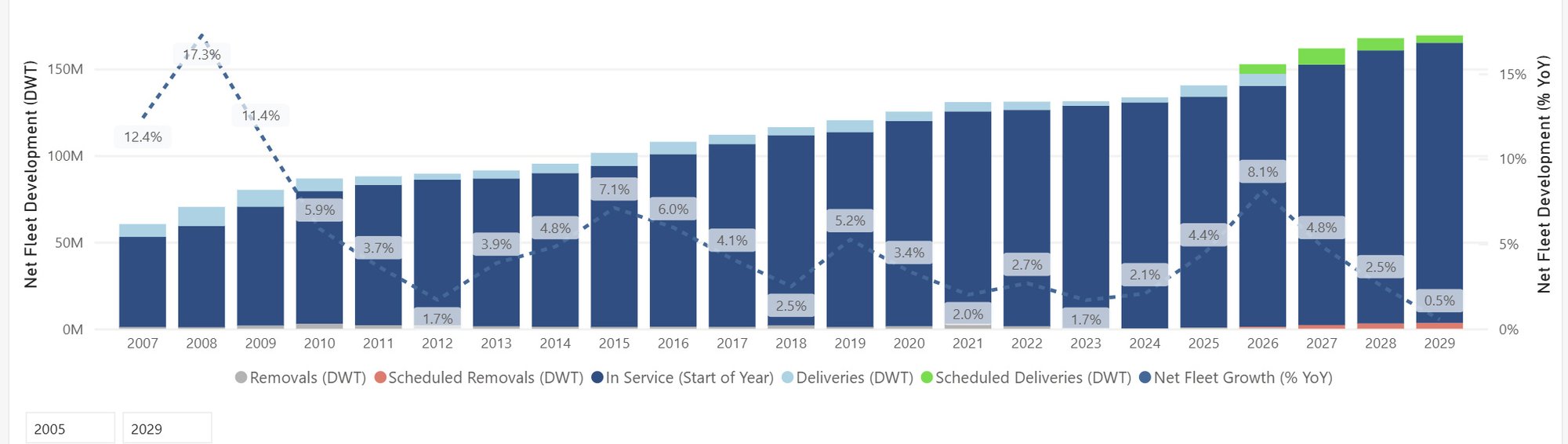
Fleet development activity continued in August, with new orders spanning MR and stainless steel chemical tankers from owners including Yangzijiang Maritime, DM Shipping, and Taikun Shipping, alongside Tailwind Management’s sale of two J19 stainless steel tankers. Deliveries from this month’s contracting are concentrated in 2028 and 2029, adding to forward supply rather than near-term availability, while the orderbook for smaller stainless steel and MR tonnage remains modest relative to an ageing in-service fleet. Combined with a fleet running 8.1% ahead of last year and next-year growth projected at 4.8%, August’s activity points to continued expansion concentrated in mid-size chemical and product tonnage over the next several years.
| Yangzijiang Maritime Development (YZJ Maritime) have ordered four option two 28,000MT stainless steel chemical tankers from Zhoushan Ningshing Shipyard with delivery 2028/29. | |
| Yangzijiang Maritime Maritime have also ordered four 50,000MT MR’s from Jiangsu Haifeng Shipbuilding with delivery 2028-29. | |
| Tailwind Management have sold the Hansa Tankers operated vessels Loevstakken and Damsgaard with Tradewinds reporting the buyer to be Clear Ocean. Both vessels are J19 stainless steel chemical tankers built at Fukuoka, Japan in 2015/16 respectively. | |
| South Korean ship owners DM Shipping and Taikun Shipping have each ordered one 33,000MT DWT stainless steel chemical tankerfrom Anhui Zhongrun with delivery in 2028. |
Current Year Growth vs. Previous Year Growth
8.1%
Total fleet DWT this year is running 8.1% ahead of last year, combining the in-service fleet at the start of the year with deliveries completed so far, net of scheduled removals. This reflects the fleet's actual net growth to date.
Next Year Growth vs. Current Year Growth
4.8%
Total available DWT is projected to grow a further 4.8% next year versus this year's year-end position, based on scheduled deliveries throughout the year net of anticipated removals from the fleet.
Next Year + 1 Fleet Growth vs. Next Year
2.5%
Fleet DWT two years out is projected to grow a further 2.5% above next year's total, based on scheduled deliveries net of expected removals. With standard newbuild lead times of around 18 months, this figure sits toward the edge of reliable forecasting and may shift as new orders are placed.
CKB Fleet tracks every delivery, removal, and order across 5,100+ vessels, updated daily by sector experts. This is not scraped or automated. Every record, from simple epoxy-coated vessels to deep-sea stainless steel super-segregators, is maintained by people who know this market. Approximately 40 updates a day keep it that way.
Brent crude jumps 55% as the Strait of Hormuz escalation reshapes freight markets. SPI Marine's July 2026 chemical tanker market report and fleet... Read More.
A tanker was hit by projectiles near Khasab while exiting the Strait of Hormuz, Iran reported two tankers disabled by mines, and Riyadh accused Iran... Read More.
US Gulf to West Coast India chemical shipping rates held flat in Week 35, with fixture activity picking up on glycols and a rare methanol cargo. Read More.