September 2026 Monthly Chemical & Tanker Report

Share on LinkedIn


This Month at a Glance

Monthly Report September 2026
EXECUTIVE SUMMARY

Tonnage Tightens as Hormuz Stays Officially Closed

September’s defining story was tightening vessel supply. US Gulf export lanes moved from balanced conditions to a firmer footing, led by the Mediterranean and West Coast India, while the Baltic Exchange MR Atlantic Basket rebounded from a $20,000 low on September 9 to $58,000 per day at month-end. Elevated bunker costs ran through nearly every lane as Brent crude held near $100 a barrel. The Strait of Hormuz ended the month still officially closed as diplomacy replaced escalation at sea, and the Red Sea emerged as a second pressure point.

Americas Market Overview

September saw US Gulf chemical tanker export markets move from broadly balanced conditions to a firmer footing across most major deep-sea tradelanes, supported by tightening vessel availability and elevated bunker costs. Cargo inquiry stayed healthy across a diverse range of commodities, but the principal driver was reduced prompt availability as more ships were committed to longer-haul voyages. Conditions strengthened most noticeably in the second half of the month as remaining September space became increasingly scarce, though activity stayed uneven and not every inquiry translated into a concluded fixture.

Ongoing disruption and geopolitical uncertainty around the Strait of Hormuz helped underpin energy prices and contributed to rising bunker costs, a cost layer that ran through nearly every lane. Fixing patterns differed by corridor. Mediterranean and West Coast India firmed most visibly, Northwest Europe built gradually after a sideways start, and ECSA and the Far East held closer to stable as additional October space emerged.

As the fourth quarter begins, the question is whether cargo demand can keep pace with growing October tonnage. Firm fundamentals, elevated bunker costs and continued geopolitical uncertainty provide underlying support, but much of the recent strength has come from tightening vessel supply rather than a material surge in demand. A healthy conversion of inquiry into fixtures could keep freight levels well supported, while slower cargo absorption could point to a more balanced and potentially softer market as the quarter progresses.

Transatlantic

The US Gulf to Northwest Europe market gradually strengthened through September after spending much of the month trading sideways. Early on, ample vessel availability and limited fixture activity kept rates largely unchanged despite healthy contract demand and spot interest in styrene, MTBE, ethanol, acetic acid and VAM. As the month progressed, a large share of available tonnage was fixed elsewhere on longer-haul voyages, tightening prompt supply and leaving remaining September space increasingly scarce.

Together with higher bunker costs, that tighter supply supported more selective cargo choices and a move to higher freight levels, though fixture activity stayed sparse. Forward inquiry for early October is encouraging, but much of it remains uncommitted, so the durability of the gains depends on whether cargo volumes keep pace as the October position list builds.

Watch Item

Whether post-EPCA demand emerges with enough force to absorb the October tonnage now building on the position list. 


West Coast India

The US Gulf to West Coast India tradelane held stable in the first week of September, with an outsider vessel going on berth against a high-paying specialty cargo, before firming through the middle of the month as tightening US Gulf tonnage combined with a sharp rise in bunker costs. A pocket of space that appeared after COA nominations concluded was fixed, thinning the position list, and owners pointed to higher bunker costs and the MEG rate environment as evidence that the market had moved, with some success.

Fresh inquiry outside large MEG cargoes stayed limited, and an owner failed on multiple charterers for a 24,000 metric ton MEG cargo. Rates held steady into the final week, with MEG consistently quoted but not converting to fixtures. A new factor has emerged in quiet chemical shipments from the Arabian Gulf to West Coast India, which may be competing with US Gulf export volumes.

Watch Item

Whether MEG, ethanol and phenol inquiry converts to fixtures before fresh tonnage enters the position list, and whether Arabian Gulf shipments into West Coast India grow into a visible competitor for US Gulf volumes. 


Far East

The US Gulf to Far East market remained largely stable throughout September. Tight prompt space early in the month supported freight levels and produced premiums on date-sensitive September loadings, but additional space emerged as October approached through COA coverage and open vessel positions, easing the earlier supply constraints and creating a more balanced market. Rates on 5,000 and 10,000 metric ton parcels held broadly steady while larger parcels edged higher.

Elevated bunker costs continued to shape owners' freight expectations, but limited fresh inquiry and a lack of spot fixture activity kept the market largely rangebound. Entering the fourth quarter, direction will depend on how quickly October and November space is absorbed and whether demand strengthens enough to support further gains.

Watch Item

How quickly October and November space is absorbed, and whether CPP strength out of the US Gulf, already feeding through to smaller chemical tankers, may translate into upward pressure on 30,000 to 40,000 metric ton parcels.


South America

The US Gulf to East Coast South America market strengthened in the first half of September on improving inquiry for lubes, EDC, methanol and styrene, with rates rising across all parcel sizes as October demand began to emerge. Momentum faded toward month-end as available vessel space proved sufficient to meet demand, several anticipated cargoes failed to materialize and regular operators continued to carry open October positions. Higher bunker costs and steady contract activity provided some underlying support, and rates eased slightly before holding broadly flat in the final week.

Looking ahead, the market is expected to remain stable to firm, with the pace of nominated contract volumes and the conversion of spot October requirements into concluded fixtures determining whether that tone is sustained or tested.

Watch Item

Whether nominated contract volumes come forward and spot October requirements convert into fixtures while space remains available across both halves of October. 


Mediterranean

The US Gulf to Mediterranean lane firmed through September as tightening vessel availability, elevated bunker costs and ongoing Middle East uncertainty supported freight levels. What began as strength in full cargoes extended into the parcel market as September positions tightened and prompt space became increasingly scarce. Upward pressure built further in the final week, with October cargoes fixing at premiums to those concluded for September. East Mediterranean discharge points continued to command a premium over the West Mediterranean.

With prompt space largely exhausted and little outsider tonnage available, the lane enters October on a firm footing, although any meaningful replenishment of vessel supply could moderate the recent upward momentum.

Watch Item

Whether fully open ships come on berth to the Mediterranean. Part-cargo space could soften if they do, but those options appear very limited at present.


Asia Market Overview

Asia lanes split by direction in September. Space stayed tight within the Inter Far East and northbound chemical movement from Southeast Asia stayed weak, while COA business from Asia to India and within Southeast Asia held stable.

Inter Far East: Weather Keeps Space Tight

Severe weather in the Inter Far East kept the space situation tight, with Korean owners already working on November positions. A suitable coastal position from Yosu Jung Hung to Yosu Anchorage could not be found for October, as owners cited vessel delays and schedule disruptions.

Northbound from Southeast Asia: Palm Strength, Chemical Weakness

Northbound movement from Southeast Asia remained weak for chemicals but stayed good for palm-related products moving into China, where freight for palm-related products stayed higher. Prompt enquiries from a COA charterer were covered by COA owners or spot vessels in the market.


Europe Market Overview

MR Atlantic Basket Rallies Into Month-End

The Baltic Exchange MR Atlantic Basket swung sharply through September. It opened the month at $28,000 per day, fell to a low of $20,000 on September 9, then rallied strongly to finish at $58,000 per day, up 26% week on week. That September low sat well above August's mid-month trough of $13,118, though the basket still has some way to go to reach the year high of $112,755 per day recorded on April 13. At month-end TC2 is running at $29,000 per day and TC14 at $49,000 per day.

MR Atlantic Basket
$28,000 → $20,000 low

(September 9)

TC2 & TC14
$29,000/day and $49,000/day

 at month-end

Westbound Chemicals Soften Further

Westbound chemical freight continued to soften for 5,000 metric ton parcels, easing from an August monthly average of $60 per metric ton to $56 and yet to recover from the summer lull. This route traditionally rallies as the winter months approach.

Panama Canal Transit Cuts Look Set to Intensify Slot Competition

The Panama Canal Authority looks set to reduce the number of transits as a direct result of El Niño predictions. That will intensify competition for pre-arrival slots, and owners unwilling to pay could face extended waits.


Bunkers

Bunker prices rose at all four benchmark ports in September as renewed US-Iran escalation kept Brent near $100 per barrel. Month-on-month, HSFO gained 11% to 12% at every port, MGO gained 10% to 16%, and VLSFO moved between 4.5% at Singapore and 17.3% at Fujairah. MGO averaged more than double its January level at all four ports.

Supply conditions explain the spread between ports. Fujairah remained severely constrained across all fuel grades, with 12 Strait of Hormuz transits recorded on September 25 against a pre-war average of 140, and its VLSFO averaged $77/mt above Singapore. Prompt availability in Amsterdam-Rotterdam-Antwerp stayed tight, with traders recommending lead times of 5 to 7 days. Fuel oil inventories at Singapore, Amsterdam-Rotterdam-Antwerp and Fujairah were reported about 30% below three-year seasonal averages.

Watch Item

MABUX expects continued volatility in October as Middle East developments and supply constraints persist. The IMO's Marine Environment Protection Committee is scheduled to vote on the Net-Zero Framework on December 4. 

Weekly average bunker prices, Week 36 vs. Week 40 ($/mt)
HSFOLSFOMGO
Wk36Wk40% Diff.Wk36Wk40% Diff.Wk36Wk40% Diff.
Singapore$635.00$734.6715.7%$843.75$856.001.5%$1,238.13$1,280.673.4%
Rotterdam$570.50$626.679.8%$680.00$682.670.4%$1,362.50$1,377.671.1%
Houston$538.00$561.004.3%$727.25$745.332.5%$1,329.75$1,427.007.3%

Iran Watch

Escalation at sea gave way to diplomacy through September, but the Strait of Hormuz ended the month still officially closed and the Red Sea emerged as a second pressure point. The month opened with the escalation that closed August still in motion. A tanker was struck by projectiles near Khasab, Riyadh accused Iran of attacking the Saudi-owned supertanker Sidr north of the Musandam Peninsula, killing two sailors, and Iran's Revolutionary Guard reported two oil tankers disabled by sea mines. Over the first ten days the Guard reported missile launches at US warships and attacks on tankers it said were using unauthorised routes, while CENTCOM said it destroyed five Iranian crude oil carriers and continued its blockade of Iranian ports. CENTCOM's running count of redirected commercial vessels rose from 87 on September 3 to 103 on September 15, the last update in the source material.

Diplomacy took over from mid-month without producing a breakthrough. A planned meeting in Oman between Iran and Gulf states on Hormuz shipping was postponed, with Iran attributing the delay to Saudi Arabia and events in Yemen. Contacts then ran through Qatari mediation around the UN General Assembly. Iran put forward a seven-day plan to reopen the Strait on September 25 and President Trump rejected it the following day. Further indirect talks followed, and on September 30 Iran said it had received a US response and that its senior leaders were reviewing the counterproposal. Tehran's stated conditions are an end to the war on all fronts, the unfreezing of Iranian funds and an end to the US blockade of Iranian ports, and Iran's parliament speaker said the Strait will stay closed until the US fulfils its commitments under the deal signed in June.

For vessels, the risk picture hardened on the approaches to the Strait. The Revolutionary Guard said it would announce a restricted area running from Chabahar into the Gulf of Oman and the Arabian Sea, with ships passing through it to be sanctioned. It later reported a supertanker on fire after striking mines in a restricted zone south of Hormuz on September 14 and a strike on a Togo-flagged tanker attempting what it called illegal passage on September 17. An Indian crew member was killed after a vessel was attacked off the coast of Oman on September 23. US statements pointed to Hormuz flows nearly back to pre-war levels and to a record overnight transit on September 27, claims that sit against Iran's position that the Strait remains closed. On the sanctions side, the US Treasury designated an Iranian cryptocurrency exchange over alleged payments linked to passage through the Strait and extended its Iran sanctions to 2031.

A second front opened in the Red Sea. Houthi forces took control of Yemen's Red Sea coast around mid-month, including the port of Mocha, claimed the Hanish islands and exchanged strikes with Saudi Arabia, raising the risk to Bab-el-Mandeb transits. Saudi Arabia suspended its East-West oil pipeline on September 11 after a drone attack it said was launched from Iraq, closing the kingdom's only crude export route that bypasses Hormuz, and some physical oil cargoes in Europe traded above $130 a barrel on September 15. Prices eased on reports of additional Saudi crude shipments through Oman and reached an 11-day low on September 21 as UN General Assembly week raised hopes of diplomatic progress. The Houthis claimed attacks on an Aramco facility at Yanbu, which Saudi-led coalition forces said were thwarted, and France said it would send troops and defense systems to help protect the port.

The standoff broke down at month-end. A U.S. strike on Larak Island on August 30 killed three people and drew Iranian missile strikes on bases in Jordan, later extending to Kuwait and the UAE in early September. Direct attacks on commercial tankers followed: a vessel was struck by projectiles near Khasab while exiting the Strait, Iran reported two tankers disabled by sea mines mid-transit, and Saudi Arabia accused Iran of attacking the supertanker Sidr, killing two crew. Underwriters are expected to reprice war risk on Strait transits and Gulf load ports accordingly, an added cost layer on top of Brent's move back above $90 covered in Bunkers.


Watch Items
  • Response to the reopening proposal. Iran is reviewing a US counterproposal received on September 30, after the US rejected the seven-day plan. Reopening and renewed escalation both remain possible outcomes, and President Trump has said the war will end "very soon one way or the other."
  • Early-November timing. Both sides referenced the US midterms as a marker. President Trump said the war would end and oil prices would fall after the elections, and Iran's president said Tehran wants the US back in the memorandum of understanding before them.
  • Transit rules and sanctions exposure. The restricted zone south of the Strait, two reports of mine strikes and the September 23 crew fatality keep vessel safety a live concern, and the Treasury action over passage-linked payments points to sanctions scrutiny of any payment tied to transit.
  • Red Sea and Yanbu. Whether the East-West pipeline resumes, and whether Houthi attacks reach Yanbu or Red Sea shipping, will shape both crude availability and Bab-el-Mandeb risk.
  • Bunker and freight linkage. The same Hormuz and Red Sea backdrop sits behind the elevated bunker costs cited across the US Gulf lanes in the Americas section.

Panama Canal

September brought a reversal in Neopanamax conditions. On September 4, the ACP postponed the cut to 47.5 feet that had been scheduled for October 1. On September 28 it raised the maximum authorized draft to 49.0 feet (14.94 m), one foot above the 48.0-foot ceiling in place since August 26. Neopanamax daily booking slots increase from nine to ten for booking dates beginning October 15, bringing total daily Canal capacity to 33 slots, and per-customer booking limits at the Neopanamax Locks were lifted.

August throughput averaged 33.19 oceangoing transits per day, down from 34.03 in July, with Canal Waters Time averaging 34.90 hours. Most chemical and product tanker tonnage transits the Panamax Locks, where September's changes were a booking rule clarification (the consecutive-date limit now applies only within a single booking period) and scheduled maintenance outages that reduce booking capacity to 23 slots on affected dates.

Watch item: The late cancellation surcharge (Tariff No. 1050.IBC9) remains postponed with no announced start date, and Panamax maintenance outages are scheduled through November.


Maritime News

stolt-tankers-logo Reported Q3 2026 (quarter to 31 August) net profit of $84.4 million on revenue of $776.5 million, against $64 million and $699.9 million a year earlier. The result includes a $15.4 million gain from selling a 50% interest in Avenir LNG. Stolt Tankers' operating profit was $52.1 million, down from $57.2 million. Average deep-sea TCE was $24,121/day, down from $24,838/day. CEO Udo Lange said higher average freight rates were outweighed by lower volumes and rising bunker costs. CFO Alex Ng said chemical tanker rates have improved only modestly from pre-war levels, while inventories of key products are near multi-year lows. He pointed to restocking as a potential catalyst for chemical demand.
hafnia Agreed on 24 September to buy a further 1.7 million Torm A shares at $34.00 per share, equal to 1.66% of Torm's share capital. The purchase lifts Hafnia's holding to roughly 19.85%, up from the 13.97% reported at Q2 quarter-end in our August edition.
top-ships Closed the acquisition of three SPVs on 30 September. Each SPV holds a contract for a scrubber-fitted ECO MR product tanker due in 2029. All three vessels have five-year time charters with an oil major from delivery, with a one-year extension option.
DNV Alternative-fuel newbuilding orders reached 69 in September, the strongest month since October 2024. Q3 orders totalled 168. LNG accounted for 48 of September's orders, mainly container ships and car carriers. The ethanol/methanol orders were all bulk carriers, and none of the month's alternative-fuel orders were tankers.

Fleet Development

Fleet development activity in September centered on small and mid-size stainless steel chemical tonnage. Nanjing Shenghang, Uni-Tankers and Augusta Due placed orders, alongside a mixed tanker and bulker programme from Union Maritime. As in August, deliveries are concentrated in 2028 and later, so they add to forward supply rather than near-term availability. Secondhand activity was busiest in MRs. Indonesian buyers were among the most active, and modern eco tonnage commanded firm prices against stable MR2 values.

Fleet News

Nanjing Shenghang Shipping has ordered six 13,500MT stainless steel chemical/product tankers from China Merchants Jinling (Nanjing) for delivery 2028–2030. The order is valued at about $148 million, and each vessel will have 14 segregations.
Uni-Tankers has arranged eight 7,600MT stainless steel chemical tankers from Haidong Shipyard, Taizhou, with deliveries from 2028. Uni-Tankers will take the vessels on time charter rather than own them. The owner has not been disclosed.
Italian owner Augusta Due (Brullo family) has ordered three 40,800MT oil/chemical tankers from Anhui Shipyard. Delivery and price have not been disclosed.
Union Maritime has ordered nine newbuildings covering Newcastlemax and handysize bulkers plus chemical and product tankers. The split by type, yards, prices and delivery schedule have not been disclosed.
Quantum Global has bought the 49,900MT MR2 PM Regent (2018, JMU) for $45.5 million, with drydock due.
Buana Lintas Lautan has bought the 46,800MT MR2 Lady of Doria (2006, Naikai Setoda) for $14.8 million. Separately, Indonesian buyers have taken the 50,000MT MR2 Xing Tong 799 (2011, Onomichi) for $27.2 million.
French buyers have acquired the 13,000MT small tanker BS Haiphong (2024, Pha Rung) for $29 million.

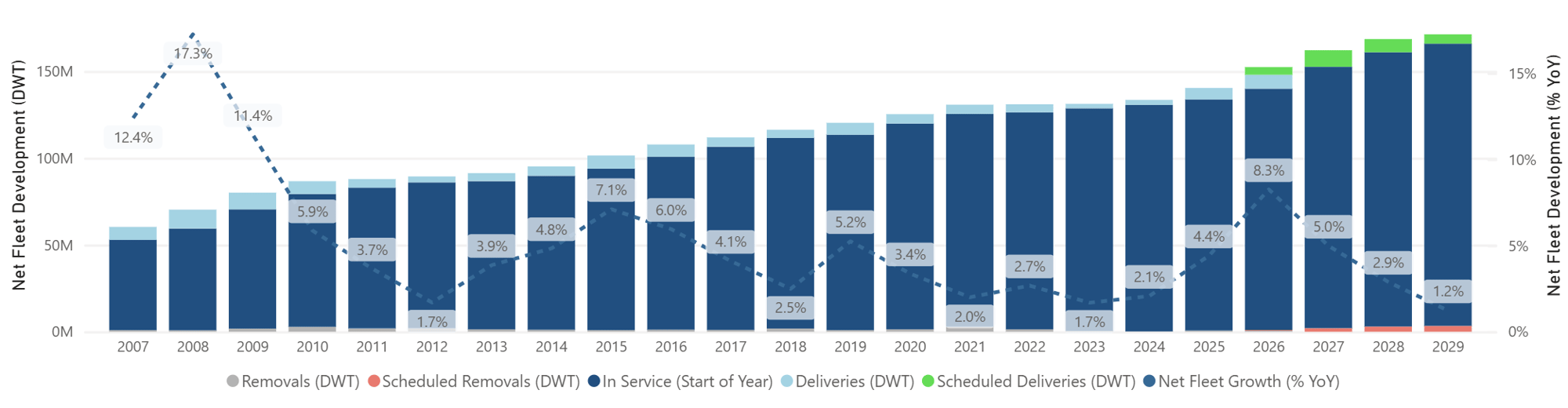
Current Year Growth vs. Previous Year Growth

8.3%

Total fleet DWT this year is running 8.1% ahead of last year, combining the in-service fleet at the start of the year with deliveries completed so far, net of scheduled removals. This reflects the fleet's actual net growth to date.

Next Year Growth vs. Current Year Growth 

5.0%

Total available DWT is projected to grow a further 4.8% next year versus this year's year-end position, based on scheduled deliveries throughout the year net of anticipated removals from the fleet.

Next Year + 1 Fleet Growth vs. Next Year

2.9%

Fleet DWT two years out is projected to grow a further 2.5% above next year's total, based on scheduled deliveries net of expected removals. With standard newbuild lead times of around 18 months, this figure sits toward the edge of reliable forecasting and may shift as new orders are placed.

Net Fleet Growth

CKB Fleet CTA

This is a snapshot. The platform is the full picture. 

CKB Fleet tracks every delivery, removal, and order across 5,100+ vessels, updated daily by sector experts. This is not scraped or automated. Every record, from simple epoxy-coated vessels to deep-sea stainless steel super-segregators, is maintained by people who know this market. Approximately 40 updates a day keep it that way. 

Latest from The Current